Articles in the Uncategorized category

  1. RAID Array Size and Rebuild Speed

    Sat 03 April 2010

    When a disk fails of a RAID 5 array, you are no longer protected against (another) disk failure and thus data loss. During this rebuild time, you are vulnerable. The longer it takes to rebuild your array, the longer you are vulnerable. Especially during a disk-intensive period, because the array must be reconstructed.

    When one disk fails of a RAID 6 array, you are still protected against data loss because the array can take a second disk failure. So RAID 6 is almost always the better choice. Especially with large disks (1+ TB), because the rebuild time largely depends on the size of a single disk, not on the size of the entire RAID array.

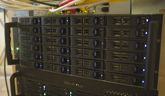
    However, there is one catch. The size of the RAID array matters when it becomes big, 10+ drives or more. No matter if you use hardware- or software- based RAID, the processor must read the contents of all drives simultaneously and use that information to rebuild the replaced drive. When creating a large RAID array, such as in my storage array, with 20 disks, the check and rebuild of the array becomes CPU-bound.

    This is because the CPU must process 1,1 GB/s (as in gigabyte!) of data and use that data stream to rebuild that single drive. Using 1 TB drives, it checks or rebuilds the array at about 50 MB/s, which is less than half what the drives are capable of (100+ MB/s). Top shows that indeed the CPU is almost saturated (95%). Please note that a check or rebuild of my storage server takes about 5 hours currently, but that could be way shorter if the CPU was not saturated.

    My array is not for professional use and fast rebuild times are not that of an issue. But if you're more serious about your setup, it may be advised to create more smaller RAID vollumes and glue them together using LVM or some similar solution.
    Tagged as : Uncategorized
    If you have any comments email me, see the About page for contact details.
  2. 'Linux: Monitor a Directory for Files'

    Mon 22 March 2010

    Inotify is a mechanism in the Linux kernel that reports when a file system event occurs.

    The inotifywait comand line utility can be used in shell scripts to monitor directories for new files. It can also be used to monitor files for changes. Inotifywait must be installed and is often not part of the base installation of your Linux distro. However, if you need to monitor a directory or some task like that, it is worth the effort. (apt-get install inotify-tools).

    Here is how you use it:

    inotifywait -m -r -e close_write /tmp/ | while read LINE; do echo $LINE | awk '{ print $1 $3 }'; done

    Let's dissect this example one part at a time. The most interesting part is this:

    inotifywait -m -r -e close_write /tmp/

    What happens here? First, inotifywait monitors the /tmp directory. The monitoring mode is specified with the -m option, otherwise inotifywait would exit after the first event. The -r option specifies recursion, beware of large directory trees. The -e option is the most important part. You only want to be notified of new files if they are complete. So only after a close_write event should your script be notified of an event. A 'create' event for example, should not cause your script to perform any action, because the file would not be ready yet.

    The remaining part of the example is just to get output like this:

    /tmp/test1234/blablaf

    /tmp/test123

    /tmp/random.bin

    This output can be used to use as an argument to other scripts or functions, in order to perform some kind of action on this file.

    This mechanism is specific to Linux. So it is not a OS independent solution.

    If you have any comments email me, see the About page for contact details.

Page 19 / 40