Articles in the Networking category

  1. Overview of Open-Source Load Balancers

    Wed 07 August 2013

    I was looking at open-source load balancing software and it seems that there isn't a nice overview except from this website, although many of the listed projects seem dead.

    I've made a selection of products that seem to be relevant. The biggest problem with open-source software is that projects are abandoned or unmaintained. So I created this table and added a column 'last product update' which gives you a feel for how active the project is.

    Product Last product update
    ngnix 2013 July
    Lighttpd November 2012
    HAproxy 2013 June
    Pound 2011 December
    Varnish 2013 June
    Zen Load Balancer 2013 February
    Apache 2013 July
    Linux Virtual Server Unmaintained?
    XLB HTTP Load Balancer 2009 February
    Octopus Load Balancer 2011 November
    Squid 2013 July
    Date of measurement: August 2013

    I currently don't have hands-on experience with these products. Some of those products are briefly discussed at this blog - worth a visit.

    There are many more products but most seem to be abandoned years ago. If you feel there are more products that are noteworthy but not in this list, feel free to contact me or comment about it.

    It seems that the top-3 web servers like ngnix, Apache and Lighttpd all have support for load balancing. It depends on your needs, time and knowledge if you want to invest in other products or stick with the web server software you know.

    At this location some people are talking about the pro's and con's of commercial off-the-shelve products vs. home-grown open-source solutions.

    Tagged as : load-balancing
    If you have any comments email me, see the About page for contact details.
  2. Statistics Showing Relevance of Caching Proxy

    Tue 18 December 2012

    In this day and age of dynamic web content, how relevant can a caching proxy server be? I believe that the answer could be: quite!

    I have installed a caching proxy server based on Squid, which is now used within my company. It also does content scanning using squidclamav and Clamav. I wrote an article about how to setup such a content scanning proxy.

    The thing is that I didn't much care for the actual caching functionality of Squid, I deemed the content-scanning part more interesting. But I'm quite pleased with the actual caching hit ratio.

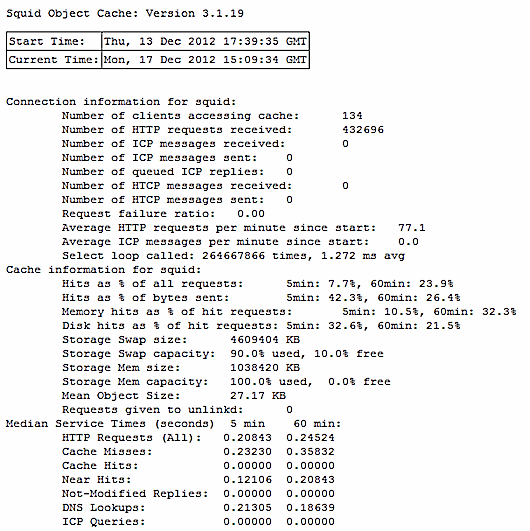
    proxy stats

    It seems that we have a hit ratio between 20% to 25% and that is more than I expected. Most content is dynamic in nature, so I would expect that most content is not cached but it seems that there is still quite some data that can be cached. This must also improve the end-user surfing experience as latency for downloading content should be reduced.

    Of course, this is just a sample for the last hour. However, multiple measurements at different moments yield similar results.

    I think this result proves that a caching proxy server is still relevant, especially if you don't have a fast internet connection. If you do, you can still improve the overall browsing experience due to the fact that data is cached.

    There is a caveat: the proxy server itself also introduces latency. I haven't performed a side-by-side comparison and measured actual responsiveness of browsing with or without a proxy.

    If you have any comments email me, see the About page for contact details.

Page 7 / 12